I know most of you never thought about that, but… GUYS.
“What Can I Do” [wɒt kæn aɪ duː] sounds awfully like “водки найду” [vɒtki naɪduː], which means “I’m gonna find some vodka”.
“Can’t Buy Me Love” [kɑːnt baɪ miː lʌv] is another gem, because I know a whole bunch of people who sing along to that with the phrase “кинь бабе лом” [kɪŋˈbɑːbi lom], which means “throw a crowbar to that [tough] woman”.
Don’t be alarmed, that’s just the way we hear things.
I do that even when I’m sober… T_T
Michael Jackson’s “I’m bad” sounds awfully close to “Обед” [abed], which translates as “Dinner”. So we often call this song ”The song of a very hungry man” 😉
Here are some song lyrics that everyone in Serbia makes fun of:
“Another One Bites the Dust” – Радован баца даске (Radovan baca daske) which means “Radovan is throwing the boards”
“Message In a Bottle” – Месечина, бато (Mesechina, bato) which means “Moonlight, my brother”
“Oye Como Va, mi ritmo” – Ко је конобар? Милинко! (Ko je konobar? Milinko!) which means “Who is the waiter? Milinko!” < Serbian name
I don’t even know. It’s from a book about languages my friend’s been reading. (it’s creepy that I can understand it …)
It was actually invented with that purpose: anyone who spoke any European language should be able to understand esperanto. It was meant to be a lingua franca.
STOP WHAT YOU’RE DOING Y’ALL AND TELL ME IF YOU UNDERSTAND THIS
I,understand about a half of it, I speak some dutch
“What Happened? Did your computer catch a virus? Did you suddenly develop BSE [mad cow disease]?”
Between German, English, Latin, a bit of French, Dutch, Spanish and Italian that was actually pretty readable to me.
I speak English and a very little spanish, and I can read it.
As some of you may know, there is a great lack of resources for my target language, Albanian. So I have to get creative. I can’t use a site like LingQ for reading and keeping track of words, but I can still do something similar with a Word Cloud! Surely the ability to consume more volume of material through LingQ is preferred, however, there’s a lot to be gained from doing the work yourself rather than having an app do it for you.
Make sure to follow @kuantikeshqip for more posts on how to learn less-popular languages (i.e., ones that aren’t on all the apps).
The Method
The gist of this method is to help you learn words through context, which has been shown to be more effective than drilling flashcards. More specifically, by identifying and learning the most frequent words in the article, you will have an easier time with understanding your reading even if you don’t know all the words.
If you’re a complete beginner, this is also a way to learn what the most common words in the language are so that you make sure you know the basics. I recommend beginners do this with multiple articles across different topics (without reading them) to get a feel for the most common words.
Find an interesting article in your target language (don’t read it yet!). If you’re using Chrome, you can translate the whole front page of a news site to decide on an article if you’re lost.
Paste the text into a Word Cloud generator. It will create a Word Cloud like the one above.
If any words you already know pop up, filter them out and regenerate the Word Cloud (I left common words in above so I could make sure I know some of the most common words).
Look up some of the new, more frequent words (they show up the largest in the cloud) in a dictionary or translator to create a primer vocab list.
Try to read the article. On the first pass, don’t look anything up. Just read. Say it out loud or use text-to-speech to also train your speaking/listening.
Read the article again, this time looking up words you don’t know. Print out the article and mark it up if you prefer it! If you don’t know most words, try translating individual words and whole sentences (see below).
Read the article one more time to test your comprehension.
Repeat as many times as you find helpful, going paragraph by paragraph with your own translation if you need to.
Type up a list of words from the article you now definitely know (should ideally include the common ones) and filter them out next time you make a Word Cloud so you are always learning new words!
Don’t stress about memorizing all the words! Just try to understand.
Here’s an example of my dissection for an article where I didn’t know most of the words (Insta):
I was asked to make a post with resources for these languages so… Here’s the folder for Serbian. This one is for Croatian and since i couldn’t find many resources, here’s a mixed folder where you can find books/audio for Bosnian.
The 75 most common words make up 40% of occurrences
The 200 most common words make up 50% of occurrences
The 524 most common words make up 60% of occurrences
The 1257 most common words make up 70% of occurrences
The 2925 most common words make up 80% of occurrences
The 7444 most common words make up 90% of occurrences
The 13374 most common words make up 95% of occurrences
The 25508 most common words make up 99% of occurrences
This article has an excellent summary on how to rapidly learn a new language within 90 days.
We can begin with studying the first 600 words. Of course chucking is an effective way to memorize words readily. Here’s a list to translate into the language you desire to learn that Derek Roger suggested! 🙂
EXPRESSIONS OF POLITENESS (about 50 expressions)
‘Yes’ and ‘no’: yes, no, absolutely, no way, exactly.
Question words: when? where? how? how much? how many? why? what? who? which? whose?
Apologizing: excuse me, sorry to interrupt, well now, I’m afraid so, I’m afraid not.
Meeting and parting: good morning, good afternoon, good evening, hello, goodbye, cheers, see you later, pleased to meet you, nice to have met.
Interjections: please, thank you, don’t mention it, sorry, it’ll be done, I agree, congratulations, thank heavens, nonsense.
Space: into, out of, outside, towards, away from,
behind, in front of, beside, next to, between, above, on top of, below,
under, underneath, near to, a long way from, through.
Time: after, ago, before, during, since, until.
DETERMINERS (about 80 words)
Articles and numbers: a, the; nos. 0–20; nos. 30–100; nos. 200–1000; last, next, 1st–12th.
Demonstrative: this, that.
Possessive: my, your, his, her, its, our, their.
Quantifiers: all, some, no, any, many, much, more, less, a few, several, whole, a little, a lot of.
Universal: everyone, everybody, everything, each, both, all, one, another.
Indefinite: someone, somebody, something, some, a few, a little, more, less; anyone, anybody, anything, any, either, much, many.
Negative: no-one, nobody, nothing, none, neither.
ADVERBS (about 60 words)
Place: here, there, above, over, below, in front, behind,
nearby, a long way away, inside, outside, to the right, to the left,
somewhere, anywhere, everywhere, nowhere, home, upstairs, downstairs.
Time: now, soon, immediately, quickly, finally,
again, once, for a long time, today, generally, sometimes, always,
often, before, after, early, late, never, not yet, still, already, then
(=at that time), then (=next), yesterday, tomorrow, tonight.
Quantifiers: a little, about (=approximately), almost, at least, completely, very, enough, exactly, just, not, too much, more, less.
Manner: also, especially, gradually, of course,
only, otherwise, perhaps, probably, quite, so, then (=therefore), too
(=also), unfortunately, very much, well.
CONJUNCTIONS (about 30 words)
Coordinating: and, but, or; as, than, like.
Time & Place: when, while, before, after, since (=time), until; where.
is “chai” a TYPE of tea??! bc in Hindi/Urdu, the word chai just means tea
its like spicy cinnamon tea instead of bland gross black tea
I think the chai that me and all other Muslims that I know drink is just black tea
i mean i always thought chai was just another word for tea?? in russian chai is tea
why don’t white people just say tea
do they mean it’s that spicy cinnamon tea
why don’t they just call it “spicy cinnamon tea”
the spicy cinnamon one is actually masala chai specifically so like
there’s literally no reason to just say chai or chai
They don’t know better. To them “chai tea” IS that specific kind of like, creamy cinnamony tea. They think “chai” is an adjective describing “tea”.
What English sometimes does when it encounters words in other languages that it already has a word for is to use that word to refer to a specific type of that thing. It’s like distinguishing between what English speakers consider the prototype of the word in English from what we consider non-prototypical.
(Sidenote: prototype theory means that people think of the most prototypical instances of a thing before they think of weirder types. For example: list four kinds of birds to yourself right now. You probably started with local songbirds, which for me is robins, blue birds, cardinals, starlings. If I had you list three more, you might say pigeons or eagles or falcons. It would probably take you a while to get to penguins and emus and ducks, even though those are all birds too. A duck or a penguin, however, is not a prototypical bird.)
“Chai” means tea in Hindi-Urdu, but “chai tea” in English means “tea prepared like masala chai” because it’s useful to have a word to distinguish “the kind of tea we make here” from “the kind of tea they make somewhere else”.
“Naan” may mean bread, but “naan bread” means specifically “bread prepared like this” because it’s useful to have a word to distinguish between “bread made how we make it” and “bread how other people make it”.
We also sometimes say “liege lord” when talking about feudal homage, even though “liege” is just “lord” in French, or “flower blossom” to describe the part of the flower that opens, even though when “flower” was borrowed from French it meant the same thing as blossom.
We also do this with place names: “brea” means tar in Spanish, but when we came across a place where Spanish-speakers were like “there’s tar here”, we took that and said “Okay, here’s the La Brea tar pits”.
Or “Sahara”. Sahara already meant “giant desert,” but we call it the Sahara desert to distinguish it from other giant deserts, like the Gobi desert (Gobi also means desert btw).
Languages tend to use a lot of repetition to make sure that things are clear. English says “John walks”, and the -s on walks means “one person is doing this” even though we know “John” is one person. Spanish puts tense markers on every instance of a verb in a sentence, even when it’s abundantly clear that they all have the same tense (”ayer [yo] caminé por el parque y jugué tenis” even though “ayer” means yesterday and “yo” means I and the -é means “I in the past”). English apparently also likes to use semantic repetition, so that people know that “chai” is a type of tea and “naan” is a type of bread and “Sahara” is a desert. (I could also totally see someone labeling something, for instance, pan dulce sweetbread, even though “pan dulce” means “sweet bread”.)
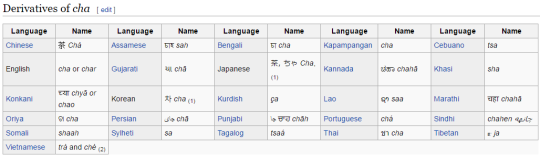
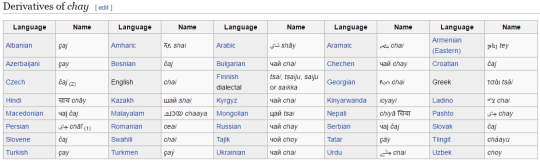
Also, specifically with the chai/tea thing, many languages either use the Malay root and end up with a word that sounds like “tea” (like té in Spanish), or they use the Mandarin root and end up with a word that sounds like “chai” (like cha in Portuguese).
So, can we all stop making fun of this now?
Okay and I’m totally going to jump in here about tea because it’s cool. Ever wonder why some languages call tea “chai” or “cha” and others call it “tea” or “the”?
It literally all depends on which parts of China (or, more specifically, what Chinese) those cultures got their tea from, and who in turn they sold their tea to.
The Portuguese imported tea from the Southern provinces through Macau, so they called tea “cha” because in Cantonese it’s “cha”. The Dutch got tea from Fujian, where Min Chinese was more heavily spoken so it’s “thee” coming from “te”. And because the Dutch sold tea to so much of Europe, that proliferated the “te” pronunciation to France (”the”), English (”tea”) etc, even though the vast majority of Chinese people speak dialects that pronounce it “cha” (by which I mean Mandarin and Cantonese which accounts for a lot of the people who speak Chinese even though they aren’t the only dialects).
And “chai”/”chay” comes from the Persian pronunciation who got it from the Northern Chinese who then brought it all over Central Asia and became chai.
Linguee This website is honestly the bomb.com. You can input almost any word/phrase/etc (even rather rare/unusual ones) and it will spit out web-searched example sentences with both the original content and the translated version. A real powerhouse of a website. I’m under the impression that the French <–> English platform is the most established.
PurpleCulture Can find you a wide variety of words and sometimes short phrases as well. Gives you the pinyin of the sentence (color-coded by tones) and allows you to click on each individual word to redirect you to its dictionary if you don’t understand the character.
Languages: Mandarin Chinese
Tatoeba You can search up example sentences contributed by users, which are in turn translated by users into multiple different languages. Probably the most versatile of these websites.
Languages: The majority of the world’s most widely-spoken languages
Forvo Not an example sentence site, but I think this one is definitely worth throwing on here. You can search for an individual word in your target language, and native speakers post audio examples of them speaking it. Really great for getting the hang of pronunciation in general and also getting used to the way people pronounce words in the real world.
Languages: The majority of the world’s most widely-spoken languages
If you know of any other sites, it would be awesome if you could add them below!! 😊