Classic Bookshelf: This site has put classic novels online, from Charles Dickens to Charlotte Bronte.
The Online Books Page: The University of Pennsylvania hosts this book search and database.
Project Gutenberg: This famous site has over 27,000 free books online.
Page by Page Books: Find books by Sir Arthur Conan Doyle and H.G. Wells, as well as speeches from George W. Bush on this site.
Classic Book Library: Genres here include historical fiction, history, science fiction, mystery, romance and children’s literature, but they’re all classics.
Classic Reader: Here you can read Shakespeare, young adult fiction and more.
Read Print: From George Orwell to Alexandre Dumas to George Eliot to Charles Darwin, this online library is stocked with the best classics.
Planet eBook: Download free classic literature titles here, from Dostoevsky to D.H. Lawrence to Joseph Conrad.
The Spectator Project: Montclair State University’s project features full-text, online versions of The Spectator and The Tatler.
Bibliomania: This site has more than 2,000 classic texts, plus study guides and reference books.
Online Library of Literature: Find full and unabridged texts of classic literature, including the Bronte sisters, Mark Twain and more.
Bartleby: Bartleby has much more than just the classics, but its collection of anthologies and other important novels made it famous.
Fiction.us: Fiction.us has a huge selection of novels, including works by Lewis Carroll, Willa Cather, Sherwood Anderson, Flaubert, George Eliot, F. Scott Fitzgerald and others.
Free Classic Literature: Find British authors like Shakespeare and Sir Arthur Conan Doyle, plus other authors like Jules Verne, Mark Twain, and more.
TEXTBOOKS
Textbook Revolution: Find biology, business, engineering, mathematics and world history textbooks here.
Wikibooks: From cookbooks to the computing department, find instructional and educational materials here.
Italian Women Writers: This site provides information about Italian women authors and features full-text titles too.
Biblioteca Valenciana: Register to use this database of Catalan and Valencian books.
Ketab Farsi: Access literature and publications in Farsi from this site.
Afghanistan Digital Library: Powered by NYU, the Afghanistan Digital Library has works published between 1870 and 1930.
CELT: CELT stands for “the Corpus of Electronic Texts” features important historical literature and documents.
Projekt Gutenberg-DE: This easy-to-use database of German language texts lets you search by genres and author.
HISTORY AND CULTURE
LibriVox: LibriVox has a good selection of historical fiction.
The Perseus Project: Tufts’ Perseus Digital Library features titles from Ancient Rome and Greece, published in English and original languages.
Access Genealogy: Find literature about Native American history, the Scotch-Irish immigration in the 19th and 20th centuries, and more.
Free History Books: This collection features U.S. history books, including works by Paul Jennings, Sarah Morgan Dawson, Josiah Quincy and others.
Most Popular History Books: Free titles include Seven Days and Seven Nights by Alexander Szegedy and Autobiography of a Female Slave by Martha G. Browne.
RARE BOOKS
Questia: Questia has 5,000 books available for free, including rare books and classics.
ARTS AND ENTERTAINMENT
Books-On-Line: This large collection includes movie scripts, newer works, cookbooks and more.
Chest of Books: This site has a wide range of free books, including gardening and cooking books, home improvement books, craft and hobby books, art books and more.
Free e-Books: Find titles related to beauty and fashion, games, health, drama and more.
2020ok: Categories here include art, graphic design, performing arts, ethnic and national, careers, business and a lot more.
Free Art Books: Find artist books and art books in PDF format here.
Free Web design books: OnlineComputerBooks.com directs you to free web design books.
Free Music Books: Find sheet music, lyrics and books about music here.
Free Fashion Books: Costume and fashion books are linked to the Google Books page.
MYSTERY
MysteryNet: Read free short mystery stories on this site.
TopMystery.com: Read books by Edgar Allan Poe, Sir Arthur Conan Doyle, GK Chesterton and other mystery writers here.
Mystery Books: Read books by Sue Grafton and others.
POETRY
The Literature Network: This site features forums, a copy of The King James Bible, and over 3,000 short stories and poems.
Poetry: This list includes “The Raven,” “O Captain! My Captain!” and “The Ballad of Bonnie and Clyde.”
Poem Hunter: Find free poems, lyrics and quotations on this site.
Famous Poetry Online: Read limericks, love poetry, and poems by Robert Browning, Emily Dickinson, John Donne, Lord Byron and others.
Google Poetry: Google Books has a large selection of poetry, fromThe Canterbury Tales to Beowulf to Walt Whitman.
QuotesandPoem.com: Read poems by Maya Angelou, William Blake, Sylvia Plath and more.
CompleteClassics.com: Rudyard Kipling, Allen Ginsberg and Alfred Lord Tennyson are all featured here.
PinkPoem.com: On this site, you can download free poetry ebooks.
MISC
Banned Books: Here you can follow links of banned books to their full text online.
World eBook Library: This monstrous collection includes classics, encyclopedias, children’s books and a lot more.
DailyLit: DailyLit has everything from Moby Dick to the recent phenomenon, Skinny Bitch.
This is a summary of college only using two pictures; expensive as hell.
That’s my Sociology “book”. In fact what it is is a piece of paper with codes written on it to allow me to access an electronic version of a book. I was told by my professor that I could not buy any other paperback version, or use another code, so I was left with no option other than buying a piece of paper for over $200. Best part about all this is my professor wrote the books; there’s something hilariously sadistic about that. So I pretty much doled out $200 for a current edition of an online textbook that is no different than an older, paperback edition of the same book for $5; yeah, I checked. My mistake for listening to my professor.
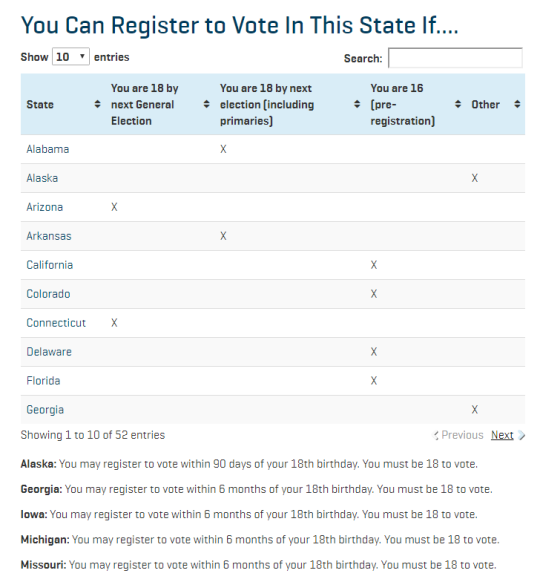
“Think you’re not old enough to register to vote? If you’re 17 and will be 18 by Election Day, chances are you can. Check out our chart below that details when you are eligible to register or preregister in your state, and when you can start voting!”
The info’s all at the site, in table format, but here it is on your dash as a list. The 50 states, Washington, D.C., and Puerto Rico, all alphabetized.
Alabama: you may register to vote if you are 18 by the next election, including primaries.
Alaska: you may register to vote within 90 days of your 18th birthday. You must be 18 to vote.
Arizona: you may register to vote if you are 18 by the next General Election.
Arkansas: you may register to vote if you are 18 by the next election, including primaries.
California: you may pre-register to vote if you are 16.
Colorado: you may pre-register to vote if you are 16.
Connecticut: you may register to vote if you are 18 by the next General Election. Registered 17 year-olds who will be 18 by the general election can vote in primaries.
Delaware: you may pre-register to vote if you are 16. Registered 17 year-olds who will be 18 by the general election can vote in primaries.
Florida: you may pre-register to vote if you are 16.
Georgia: you may register to vote within 6 months of your 18th birthday. You must be 18 to vote.
Hawaii: you may register to vote if you are 18 by the next election, including primaries.
Idaho: you may register to vote if you are 18 by the next election, including primaries.
Illinois: you may register to vote if you are 18 by the next General Election. Registered 17 year-olds who will be 18 by the general election can vote in primaries.
Indiana: you may register to vote if you are 18 by the next General Election.
Iowa: you may register to vote within 6 months of your 18th birthday. You must be 18 to vote.
Kansas: you may register to vote if you are 18 by the next election, including primaries.
Kentucky: you may register to vote if you are 18 by the next election, including primaries. Registered 17 year-olds who will be 18 by the general election can vote in primaries.
Louisiana: you may pre-register to vote if you are 16.
Maine: you may register to vote if you are 18 by the next General Election. Registered 17 year-olds who will be 18 by the general election can vote in primaries.
Maryland: you may pre-register to vote if you are 16. Registered 17 year-olds who will be 18 by the general election can vote in primaries.
Massachusetts: you may pre-register to vote if you are 16.
Michigan: you may register to vote within 6 months of your 18th birthday. You must be 18 to vote.
Minnesota: you may register to vote if you are 18 by the next election, including primaries.
Mississippi: you may register to vote if you are 18 by the next election, including primaries. Registered 17 year-olds who will be 18 by the general election can vote in primaries.
Missouri: you may register to vote within 6 months of your 18th birthday. You must be 18 to vote.
Montana: you may register to vote if you are 18 by the next election, including primaries.
Nebraska: you may register to vote if you are 18 by the next General Election. Registered 17 year-olds who will be 18 by the general election can vote in primaries.
Nevada: you may register to vote if you are 18 by the next election, including primaries.
New Hampshire: you may register to vote if you are 18 by the next election, including primaries.
New Jersey: you may register to vote if you are 18 by the next General Election.
New Mexico: you may register to vote if you are 18 by the next General Election. Registered 17 year-olds who will be 18 by the general election can vote in primaries.
New York: you may register to vote if you are 18 by the next General Election.
North Carolina: you may pre-register to vote if you are 16. Registered 17 year-olds who will be 18 by the general election can vote in primaries.
North Dakota: does not have voter registration. You must be 18 to vote.
Ohio: you may register to vote if you are 18 by the next General Election. Registered 17 year-olds who will be 18 by the general election can vote in primaries.
Oklahoma: you may register to vote if you are 18 by the next election, including primaries.
Oregon: you may pre-register to vote if you are 16.
Pennsylvania: you may register to vote if you are 18 by the next election, including primaries.
Puerto Rico: you may register to vote if you are 18 by the next General Election.
Rhode Island: you may pre-register to vote if you are 16.
South Carolina: you may register to vote if you are 18 by the next election, including primaries. Registered 17 year-olds who will be 18 by the general election can vote in primaries.
South Dakota: you may register to vote if you are 18 by the next election, including primaries.
Tennessee: you may register to vote if you are 18 by the next election, including primaries.
Texas: you may register to vote within 2 months of your 18th birthday. You must be 18 to vote.
Utah: you may pre-register to vote if you are 16.
Vermont: you may register to vote if you are 18 by the next General Election. Registered 17 year-olds who will be 18 by the general election can vote in primaries.
Virginia: you may register to vote if you are 18 by the next General Election. Registered 17 year-olds who will be 18 by the general election can vote in primaries.
Washington: you may register to vote if you are 18 by the next election, including primaries.
Washington D.C.: you may register to vote if you are 18 by the next General Election.
West Virginia: you may register to vote if you are 18 by the next General Election. Registered 17 year-olds who will be 18 by the general election can vote in primaries.
Wisconsin: you may register to vote if you are 18 by the next election, including primaries.
Wyoming: you may register to vote if you are 18 by the next election, including primaries.
Sensory overload has been found to be associated with disorders such as:
Fibromyalgia (FM)
Chronic Fatigue Syndrome (CFS)
Post Traumatic Stress Disorder (PTSD)
Autistic spectrum disorders
Generalized Anxiety Disorder (GAD)
Synesthesia
Sensory overload occurs when one (or more) of the body’s senses experiences over-stimulation from the environment.
Basically it feels like everything is happening at once, and is happening too fast for you to keep up with.
Sensory overload can result from the over stimulation of any of the senses.
Hearing: Loud noise or sound from multiple sources, such as several people talking at once.
Sight: Bright lights, strobe lights, or environments with lots of movement such as crowds or frequent scene changes on TV.
Smell and Taste: Strong aromas or spicy foods.
Touch: Tactile sensations such as being touched by another person or the feel of cloth on skin.
Obviously, everyone reacts in differently to sensory overload.
Some behavioural examples are:
Irritability – “Shutting down” – Covers eyes around bright lights – Difficulty concentrating Angry outbursts – Refuses to interact and participate – Covers ears to close out sounds or voices – Jumping from task to task without completing Overexcitement – Low energy levels – Difficulty speaking – Compains about noises not effecting others High energy levels – Sleepiness/fatigue – poor eye contact – Overly sensitive to sounds/lights/touch Fidgeting and restlessness – Avoids touching/being touched – Muscle tension – Difficulty with social interactions
There are two different methods to prevent sensory overload: avoidance and setting limits:
Create a more quiet and orderly environment – keeping the noise to a minimum and reducing the sense of clutter.
Rest before big events.
Focus your attention and energy on one thing at a time.
Restrict time spent on various activities.
Select settings to avoid crowds and noise.
One may also limit interactions with specific people to help prevent sensory overload.
It is important in situations of sensory overload to calm oneself and return to a normal level.
Remove yourself from the situation.
Deep pressure against the skin combined with proprioceptive input that stimulates the receptors in the joints and ligaments often calms the nervous system.
Reducing sensory input such as eliminating distressing sounds and lowering the lights can help.
Calming, focusing music works for some.
Take an extended rest if a quick break doesn’t relieve the problem.
What if someone you know is experiencing sensory overload?
Recognize the onset of overload. If they appear to have lost abilities that they usually have, such as forgetting how to speak, this is often a sign of severe overload.
Reduce the noise level. If they are in a noisy area, offer to guide them somewhere more quiet. Give time to process questions and respond, because overload tends to slow processing. If you can control the noise level, for example by turning off music, do so.
Do not touch or crowd them. Many people in SO are hypersensitive to touch – being touched or thinking they are about to be touched can worsen the overload. If they are seated or are a small child, get down to their level instead of looming above them.
Don’t talk more than necessary. Ask if you need to in order to help, but don’t try to say something reassuring or get them talking about something else. Speech is sensory input, and can worsen overload.
If they have a jacket, they may want to put it on and put the hood up. This helps to reduce stimulation, and many people find the weight of a jacket comforting. If their jacket is not within reach, ask them if they want you to bring it. A heavy blanket can also help in a similar way.
Don’t react to aggression. Don’t take it personally. It is rare for someone who is overloaded to cause serious harm, because they don’t want to hurt you, just get out of the situation. Aggression often occurs because you tried to touched/restrained/blocked their escape.
When they have calmed down, be aware that they will often be tired and more susceptible to overload for quite awhile afterwards. It can take hours or days to fully recover from an episode of sensory overload. If you can, try to reduce stress occurring later on as well.
If they start self-injuring, you should usually not try to stop them. Restraint is likely to make their overload worse. Only intervene if they are doing something that could cause serious injury, such as hard biting or banging their head. It’s a lot better to deal with self-injury indirectly by lowering overload.
To summarise – Remember the 5 R’s
Recognise The symptoms of overload
Remove Yourself from the situation
Reduce the stimulus causing the overload
Relax Your body and calm yourself down
Rest Yourself as you will most likely feel fatigue.]
(the original post is a photoset and the above was part of an image description, hope no ones minds i just changed it into a text post)
Reblogging always because this is so vital.
i had no idea that this could have been sensory overload, but it really figures lmao
I didn’t know about this at all!
Omg! Thank you for this! I have GAD and I’ve experienced this so often but I never really knew what to call it or how to help myself.