So you know what I don’t get? Why people repeat words. (x)
Grammar time: it’s called “contrastive reduplication,” and it’s a form of intensification that is relatively common. Finnish does a very similar thing, and others use near-reduplication (rhyme-based) to intensify, like Hungarian (pici ‘tiny’, ici-pici ‘very tiny’).
Even the typologically-distant group of Bantu languages utilize reduplication in a strikingly similar fashion with nouns: Kinande oku-gulu ‘leg’, oku-gulu-gulu ‘a REAL leg’ (Downing 2001, includes more with verbal reduplication as well).
I suppose the difficult aspect of English reduplication is not through this particular type, but the fact that it utilizes many other types of reduplication: baby talk (choo-choo, no-no), rhyming (teeny-weeny, super-duper), and the ever-famous “shm” reduplication: fancy-schmancy (a way of denying the claim that something is fancy).
screams my professor was trying to find an example of reduplication so the next class he came back and said “I FOUND REDUPLICATION IN ENGLISH” and then he said “Milk milk” and everyone was just “what?” and he said “you know when you go to a coffee shop and they ask if you want soy milk and you say ‘no i want milk milk’” and everyone just had this collective sigh of understanding.
Another name for this particular construction is contrastive focus reduplication, and there’s a famous linguistics paper about it which is commonly known as the Salad Salad Paper. You know, because if you want to make it clear that you’re not talking about pasta salad or potato salad, you might call it “salad salad”. The repetition indicates that you’re intending the most prototypical meaning of the word, like green salad or cow’s milk, even though other things can be considered types of salad or milk.
It’s sort of the opposite of “chai tea” debate. instead of adding a non-English equivalent for the word tea to specify the TYPE of tea you are emphasizing the same word to emphasis the baseline type.
is “chai” a TYPE of tea??! bc in Hindi/Urdu, the word chai just means tea
its like spicy cinnamon tea instead of bland gross black tea
I think the chai that me and all other Muslims that I know drink is just black tea
i mean i always thought chai was just another word for tea?? in russian chai is tea
why don’t white people just say tea
do they mean it’s that spicy cinnamon tea
why don’t they just call it “spicy cinnamon tea”
the spicy cinnamon one is actually masala chai specifically so like
there’s literally no reason to just say chai or chai
They don’t know better. To them “chai tea” IS that specific kind of like, creamy cinnamony tea. They think “chai” is an adjective describing “tea”.
What English sometimes does when it encounters words in other languages that it already has a word for is to use that word to refer to a specific type of that thing. It’s like distinguishing between what English speakers consider the prototype of the word in English from what we consider non-prototypical.
(Sidenote: prototype theory means that people think of the most prototypical instances of a thing before they think of weirder types. For example: list four kinds of birds to yourself right now. You probably started with local songbirds, which for me is robins, blue birds, cardinals, starlings. If I had you list three more, you might say pigeons or eagles or falcons. It would probably take you a while to get to penguins and emus and ducks, even though those are all birds too. A duck or a penguin, however, is not a prototypical bird.)
“Chai” means tea in Hindi-Urdu, but “chai tea” in English means “tea prepared like masala chai” because it’s useful to have a word to distinguish “the kind of tea we make here” from “the kind of tea they make somewhere else”.
“Naan” may mean bread, but “naan bread” means specifically “bread prepared like this” because it’s useful to have a word to distinguish between “bread made how we make it” and “bread how other people make it”.
We also sometimes say “liege lord” when talking about feudal homage, even though “liege” is just “lord” in French, or “flower blossom” to describe the part of the flower that opens, even though when “flower” was borrowed from French it meant the same thing as blossom.
We also do this with place names: “brea” means tar in Spanish, but when we came across a place where Spanish-speakers were like “there’s tar here”, we took that and said “Okay, here’s the La Brea tar pits”.
Or “Sahara”. Sahara already meant “giant desert,” but we call it the Sahara desert to distinguish it from other giant deserts, like the Gobi desert (Gobi also means desert btw).
Languages tend to use a lot of repetition to make sure that things are clear. English says “John walks”, and the -s on walks means “one person is doing this” even though we know “John” is one person. Spanish puts tense markers on every instance of a verb in a sentence, even when it’s abundantly clear that they all have the same tense (”ayer [yo] caminé por el parque y jugué tenis” even though “ayer” means yesterday and “yo” means I and the -é means “I in the past”). English apparently also likes to use semantic repetition, so that people know that “chai” is a type of tea and “naan” is a type of bread and “Sahara” is a desert. (I could also totally see someone labeling something, for instance, pan dulce sweetbread, even though “pan dulce” means “sweet bread”.)
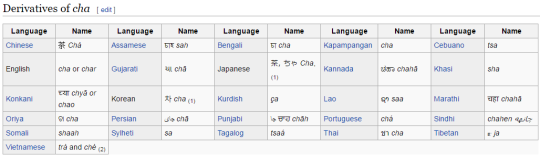
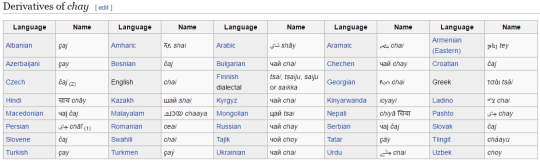
Also, specifically with the chai/tea thing, many languages either use the Malay root and end up with a word that sounds like “tea” (like té in Spanish), or they use the Mandarin root and end up with a word that sounds like “chai” (like cha in Portuguese).
So, can we all stop making fun of this now?
Okay and I’m totally going to jump in here about tea because it’s cool. Ever wonder why some languages call tea “chai” or “cha” and others call it “tea” or “the”?
It literally all depends on which parts of China (or, more specifically, what Chinese) those cultures got their tea from, and who in turn they sold their tea to.
The Portuguese imported tea from the Southern provinces through Macau, so they called tea “cha” because in Cantonese it’s “cha”. The Dutch got tea from Fujian, where Min Chinese was more heavily spoken so it’s “thee” coming from “te”. And because the Dutch sold tea to so much of Europe, that proliferated the “te” pronunciation to France (”the”), English (”tea”) etc, even though the vast majority of Chinese people speak dialects that pronounce it “cha” (by which I mean Mandarin and Cantonese which accounts for a lot of the people who speak Chinese even though they aren’t the only dialects).
And “chai”/”chay” comes from the Persian pronunciation who got it from the Northern Chinese who then brought it all over Central Asia and became chai.
I love how confused adults get with our humor and vine refrences cause like i just replied to my brother with ‘four female ghostbusters?? the feminist are taking over!!’ and he just screams ‘IM AN ADULT VIRGIN’ and my mom still has no idea what we’re talking about
Sometimes I fear we accidentally created a new language
why fear it when you can embrace it
We actually have…an updated version. You know how the idioms we have are said but never finished because it’s assumed that as long as the person you’re talking to speaks the same language they’ll understand the rest?
Ie. Jack of all trades master of none->better than a master of one
Great minds think alike->but fools rarely differ
Over time the second half gets lost because it’s been passed down orally so some idioms meanings have been warped but that’s a different conversation (ie. “Blood is thicker than water” is actually “the blood of the convent is thicker than the water of the womb”)
Vine are like that for us. You only need say the first half and every person under 30 knows the second half, no context needed. It’s cool as shit how the internet has done that for us. Vine sayings have become idioms in a sense…
things english speakers know, but don’t know we know.
WOAH WHAT?
That is profound. I noticed this by accident when asked about adjectives by a Japanese student. She translated something from Japanese like “Brown big cat” and I corrected her. When she asked me why, I bluescreened.
What the fuck, English isn’t even my first language and yet I picked up on that. How the fuck. What the fuck.
Reasoning: It Just Sounds Right
Oooh, don’t like that. Nope, I do not even like that a little bit. That’s parting the veil and looking at some forbidden fucking knowledge there.
Meanwhile, “utter” works for the first (e.g., “you utter floorboard”) but somehow “utterly” doesn’t seem to work as well for the second (“I was utterly floorboarded”).
Utterly doesn’t work for drunk because it’s the affix for turning random objects into terms for *shocked*, obviously.
… huh. I thought that might just be the similarity to “floored”, and yet “I was utterly coat hangered” does seem to convey something similar.
I have to tell you, I am utterly sandwiched at this discovery.
Completely makes the phrase mean “super tired”.
“God, it’s been a long week, I am completely coat-hangered.”
Something is
Something is wrong with our language
Is it a glitch or a feature?
Feature
I think this means you’ve been utterly linguisted.
Speaking of linguistics, there’s one particular linguistic tick that I think clearly separates Baby Boomers from Millennials: how we reply when someone says “thank you.”
You almost never hear a Millennial say “you’re welcome.” At least not when someone thanks them. It just isn’t done. Not because Millenials are ingrates lacking all manners, but because the polite response is “No problem.” Millennials only use “you’re welcome” sarcastically when they haven’t been thanked or when something has been taken from/done to them without their consent. It’s a phrase that’s used to point out someone else’s rudeness. A Millenial would typically be fairly uncomfortable saying “you’re welcome” as an acknowledgement of genuine thanks because the phrase is only ever used disengenuously.
Baby Boomers, however, get really miffed if someone says “no problem” in response to being thanked. From their perspective, saying “no problem” means that whatever they’re thanking someone for was in fact a problem, but the other person did it anyway as a personal favor. To them “You’re welcome” is the standard polite response.
“You’re welcome” means to Millennials what “no problem” means to Baby Boomers, and vice versa.The two phrases have converse meanings to the different age sets. I’m not sure exactly where this line gets drawn, but it’s somewhere in the middle of Gen X. This is a real pain in the ass if you work in customer service because everyone thinks that everyone else is being rude when they’re really being polite in their own language.
Something interesting to note is also the more literal meaning behind these two phrases and how they themselves differ and oppose each other
‘No problem’, coming from a millenials mouth, within the context of helping someone – whether it be holding a door open/picking up something someone may have dropped/ect. – and, naturally, being thanked for it, implies that the kind gesture was indeed, not a problem, that it was just the thing to do, that they were happy to help and that no thanks was really necessary.
While a Baby Boomer’s ‘You’re welcome’ in contrast, says something miles different, it actually highlights the fact that the person went out of their way to help someone; almost brings attention to it in a way, saying ‘Yeah, I helped you, I did you this favor I accept your thanks.’ which, malicious intent or not, is strikingly different than the millennial downplay of their act of kindness for the sake of helping someone.
yeah i almost ALWAYS say “Not a problem” with a smile? i think i was taught “you’re welcome” but somehow i don’t think i really say that unless i’m joking around or something…
This is why at Disney World they say “My Pleasure”. I picked that up from them for my customer service job and it’s the perfect workaround.