Carpathia received Titanic’s distress signal at 12:20am, April 15th, 1912. She was 58 miles away, a distance that absolutely could not be covered in less than four hours.
(Californian’s exact position at the time is…controversial. She was close enough to have helped. By all accounts she was close enough to see Titanic’s distress rockets. It’s uncertain to this day why her crew did not respond, or how many might not have been lost if she had been there. This is not the place for what-ifs. This is about what was done.)
Carpathia’s Captain Rostron had, yes, rolled out of bed instantly when woken by his radio operator, ordered his ship to Titanic’s aid and confirmed the signal before he was fully dressed. The man had never in his life responded to an emergency call. His goal tonight was to make sure nobody who heard that fact would ever believe it.
All of Carpathia’s lifeboats were swung out ready for deployment. Oil was set up to be poured off the side of the ship in case the sea turned choppy; oil would coat and calm the water near Carpathia if that happened, making it safer for lifeboats to draw up alongside her. He ordered lights to be rigged along the side of the ship so survivors could see it better, and had nets and ladders rigged along her sides ready to be dropped when they arrived, in order to let as many survivors as possible climb aboard at once.
I don’t know if his making provisions for there still being survivors in the water was optimism or not. I think he knew they were never going to get there in time for that. I think he did it anyway because, god, you have to hope.
Carpathia had three dining rooms, which were immediately converted into triage and first aid stations. Each had a doctor assigned to it. Hot soup, coffee, and tea were prepared in bulk in each dining room, and blankets and warm clothes were collected to be ready to hand out. By this time, many of the passengers were awake–prepping a ship for disaster relief isn’t quiet–and all of them stepped up to help, many donating their own clothes and blankets.
And then he did something I tend to refer to as diverting all power from life support.
Here’s the thing about steamships: They run on steam. Shocking, I know; but that steam powers everything on the ship, and right now, Carpathia needed power. So Rostron turned off hot water and central heating, which bled valuable steam power, to everywhere but the dining rooms–which, of course, were being used to make hot drinks and receive survivors. He woke up all the engineers, all the stokers and firemen, diverted all that steam back into the engines, and asked his ship to go as fast as she possibly could. And when she’d done that, he asked her to go faster.
I need you to understand that you simply can’t push a ship very far past its top speed. Pushing that much sheer tonnage through the water becomes harder with each extra knot past the speed it was designed for. Pushing a ship past its rated speed is not only reckless–it’s difficult to maneuver–but it puts an incredible amount of strain on the engines. Ships are not designed to exceed their top speed by even one knot. They can’t do it. It can’t be done.
Carpathia’s absolute do-or-die, the-engines-can’t-take-this-forever top speed was fourteen knots. Dodging icebergs, in the dark and the cold, surrounded by mist, she sustained a speed of almost seventeen and a half.
No one would have asked this of them. It wasn’t expected. They were almost sixty miles away, with icebergs in their path. They had a respondibility to respond; they did not have a responsibility to do the impossible and do it well. No one would have faulted them for taking more time to confirm the severity of the issue. No one would have blamed them for a slow and cautious approach. No one but themselves.
They damn near broke the laws of physics, galloping north headlong into the dark in the desperate hope that if they could shave an hour, half an hour, five minutes off their arrival time, maybe for one more person those five minutes would make the difference. I say: three people had died by the time they were lifted from the lifeboats. For all we know, in another hour it might have been more. I say they made all the difference in the world.
This ship and her crew received a message from a location they could not hope to reach in under four hours. Just barely over three hours later, they arrived at Titanic’s last known coordinates. Half an hour after that, at 4am, they would finally find the first of the lifeboats. it would take until 8:30 in the morning for the last survivor to be brought onboard. Passengers from Carpathia universally gave up their berths, staterooms, and clothing to the survivors, assisting the crew at every turn and sitting with the sobbing rescuees to offer whatever comfort they could.
In total, 705 people of Titanic’s original 2208 were brought onto Carpathia alive. No other ship would find survivors.
At 12:20am April 15th, 1912, there was a miracle on the North Atlantic. And it happened because a group of humans, some of them strangers, many of them only passengers on a small and unimpressive steam liner, looked at each other and decided: I cannot live with myself if I do anything less.
I think the least we can do is remember them for it.
wow okay i’m crying now
“And even as he watched the rescue unfolding that morning, he would have understood that for the living, everything which could have been done had been done: not a single survivor was lost or injured being brought aboard the Carpathia. For those who had gone down with the Titanic, save for reverencing their memory at the service later that day, there was nothing more that he or anyone could do. Rostron’s duty now was as he always saw it: to the living.”
I looked up a bit about this because the post is so movingly written that when I read it aloud to my husband and mother they both wept like babies, and something else really struck me about this story.
So Carpathia was not a top-end luxury liner. Her reputation was for being Jolly Comfortable – she was very broad in her proportions, and not super-duper fast, and the result was that she didn’t rock so much on the waves and you couldn’t particularly hear/feel the engines. She was solid and dependable, and lots of people liked using her, but she therefore occupied a lesser niche than Titanic or Olympian or whatever – and crucially, as a result of that, she only had one radio operator on board. This means she only had radio ops for a certain window in the day, unlike Titanic, which had 24 hour radio ops.
So on that night, when Titanic went down, Carpathia’s wireless operator – one Harold Cottam – clocked off his shift at midnight, and went to bed. While he was getting ready for bed, though, he left the transmitter on for the hell of it, and therefore picked up a transmission from Cape Race in Newfoundland, the closest transmitting tower sending messages to the ships. They told him that they had a backlog of private traffic for Titanic that wasn’t getting through. So, even though his shift was over, and it was now 11 minutes past bloody midnight, and he just wanted to go to bed, Harold Cottam decided that nonetheless, he’d be helpful, and let the Titanic know they had messages waiting.
And that’s how he received the Titanic’s distress signal. In spite of no longer being on shift to receive it, and therefore in order to send Carpathia galloping to Titanic’s rescue, and thus saving 705 people.
All because Harold Cottam decided one night to be kind.
I dunno. That’s just really stuck with me.
Cottam also ended up staying awake for something like 48 hours straight trying to send survivors messages and a list of survivors home, but due to Carpathia’s limited radio frequency range and with no other ships to act as a relay, this was rather patchy. However, he tried his damn best to make sure the survivor’s messages got home, and was also bombarded with incoming messages of bribes to spill the details of the disaster to the press.
Rostrum had ordered that no messages to the press be sent out of respect to the survivors, for they would have their privacy destroyed as soon as they reached New York. Cottam respected this order, even under extreme duress of fatigue, stress, and the knowledge that in some cases the bribes were almost three times his annual salary.
He eventually went to bed but not before working with one of the rescued Titanic’s radio operators, Harold Bride, to transmit as many messages as possible. Bride was injured (his feet had been crushed in a lifeboat) and had just passed the body of the second of Titanic’s radio operators aboard (Jack Phillips), so neither of them were really in the best shape to keep working, but they did.
In the face of extreme adversity, both men refused to do anything but their duty (and exceeding their duty) not just because Rostrum had ordered it, but because it was the right thing to do. They could have profited considerably from the disaster and they refused for the dignity of the survivors.
This is hopepunk. This is what we can be, what we are, when instinct takes over. This is what we are when we choose to care about each other. We’re not profit machines or units of production or lone fierce wolves in a bitter wilderness. We are people, and we care about people.
fandom is so weird you never know how old anyone is but you just kinda assume most of them are around your age until proven otherwise and then one day someone is talking about their 9 year old kid on your dash and another person is saying they just finished 10th grade. wild.
reblog and tag with your age, so your mutuals know
rosy sunlight: waking up unexpectedly early, enjoying the peaceful silent, laying in bed and just thinking, messy buns, the calm before the storm, deciphering your dreams, peach tones
hot coffee: productivity, writing in a journal or diary, planning out your day, a high ponytail, buying breakfast, newspapers, the smell of fresh coffee beans
cereal bowl: having something sweet for breakfast, walking your dog, morning shower, bubbly laughter, hopefulness, counting down to the weekend
alarm clock: waking up late, no makeup, coffee to wake you up, cold feet, falling back asleep when there’s a moment, cloudy skies, heavy eyelids
breakfast pastry: the bustling of a large family, staying in your pyjamas, morning radio, grocery shopping, waiting for the post, no responsibilities
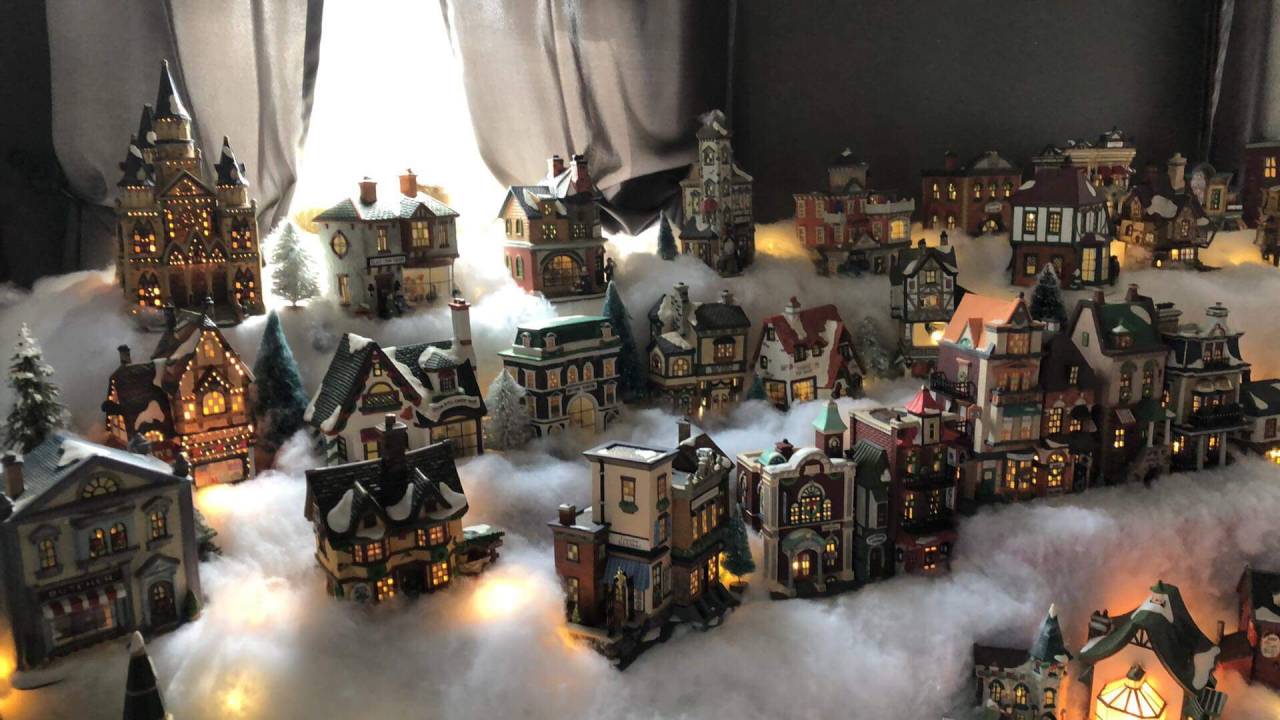
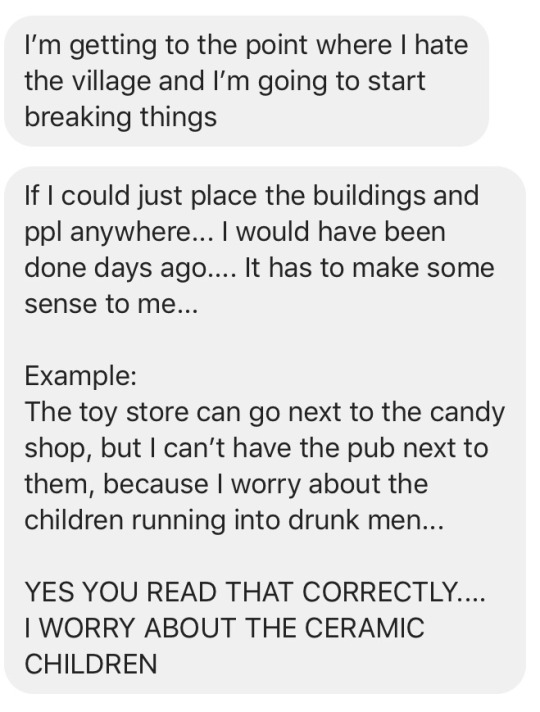
Okay in my house we have a strange tradition. My mother builds this beautiful Christmas village.
It wraps all around our house through the rooms and under the trees and it’s wonderful.
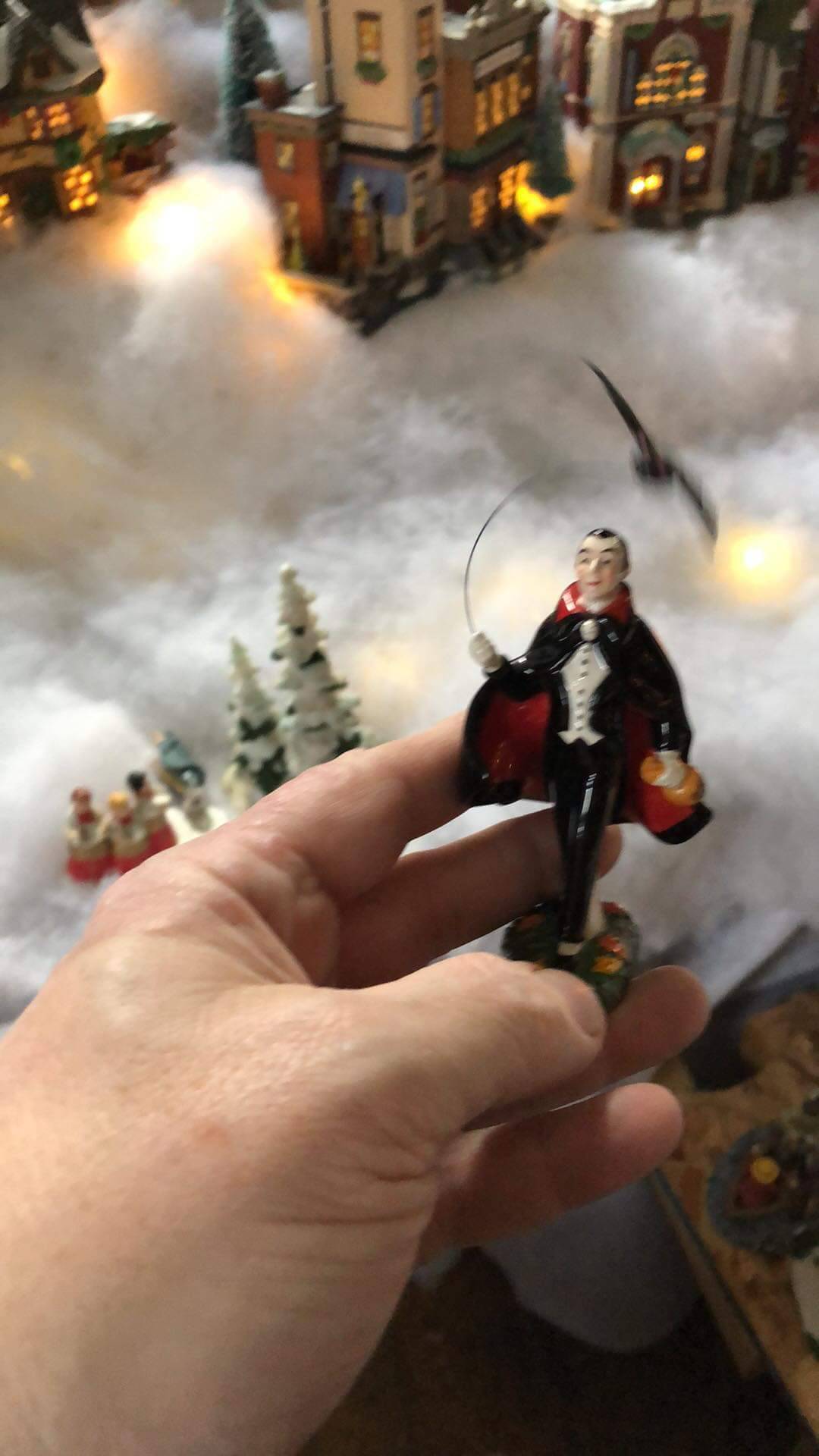
Every year she hides the Christmas Vampire
This started when I was a very small got child and spread to all of my friends, including my best friend from elementary school who I just so happened to grow up and marry. Now that we have grown up and moved nearly 600 miles away we still always go home for a week at Christmas for multiple reasons, including the Christmas Vampire.
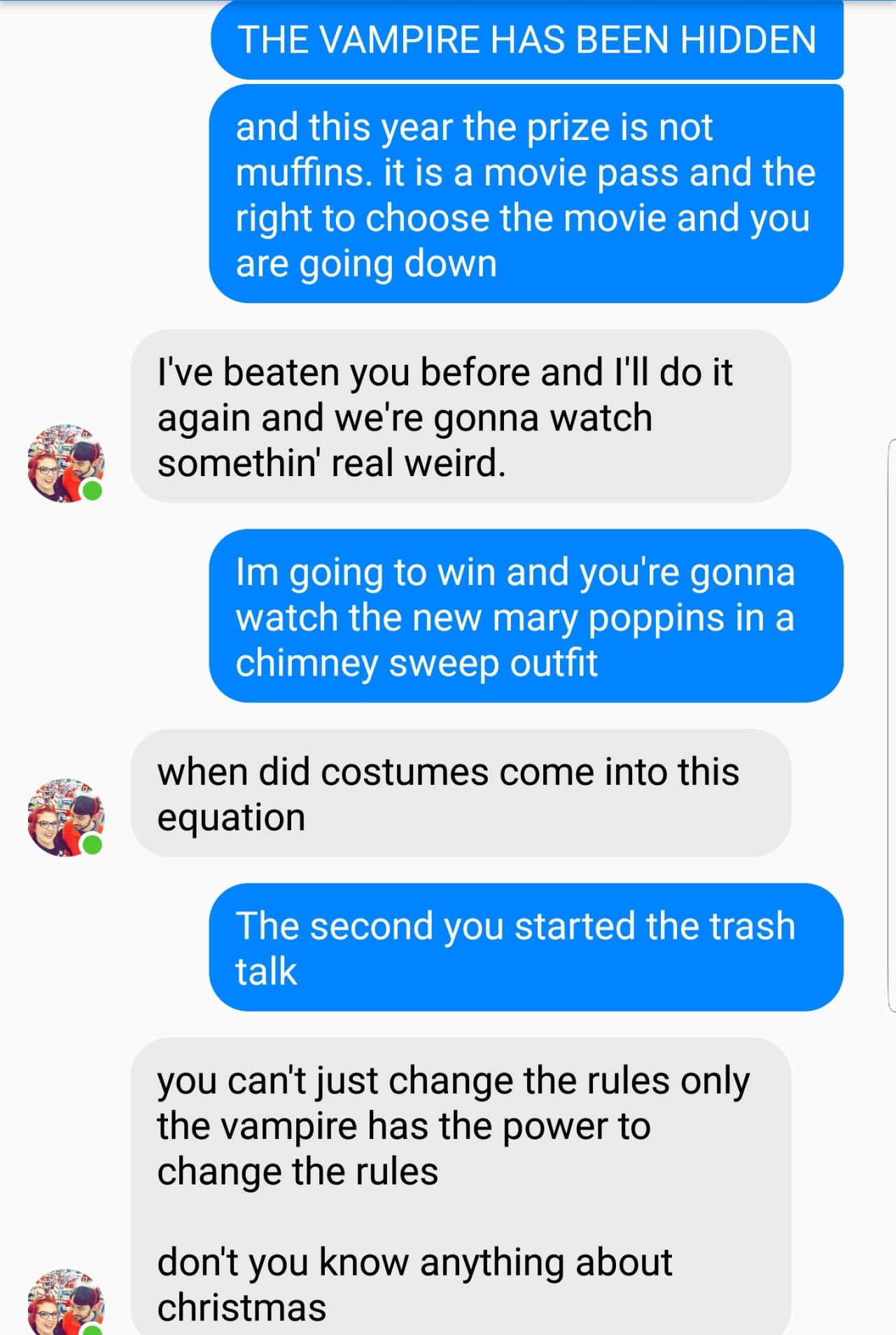
Needless to say we still partake and things have gotten heated.
Stay tuned for the epic conclusion and to see my husband and father in Lin-Manuel Miranda’s sooty costume when I find the Christmas Vampire First!
Happy Haunting!
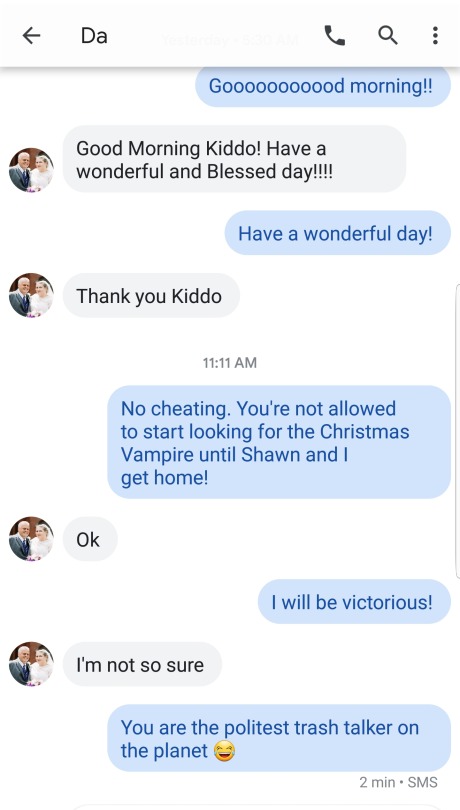
Dad has no fricken clue how to trash talk and I don’t trust him in the slightest.
The saga continues. Mom hasnt finished the village yet and it’s starting to get to her….
Oh geez, this isn’t half the story. Buckle up kids. This is wild.
The inventor is Paul Winchell, who started off doing Dummy shows on the radio. His star rises, TV happens, and he enters a dancing contest where he WON AGAINST RICARDO MONTALBALN.
Mr. Montalbaln was SO IMPRESSED that he invited Paul Winchell to dinner. At dinner he was seated next to A PRE FAME DR HEIMLICH.
YES. OF THE HEIMLICH MANEUVER.
They hit it off and somehow Paul Winchell is invited to watch Heimlich and others do operations.
AGAIN, HE’S A VENTRILOQUIST AND A HOST OF THINGS. I DON’T KNOW HOW HE WON THE DANCE CONTEST THAT STARTED THIS THING.
Which leads to the following conversation.
Winchell: Hey, what if someone invented an artificial heart so someone can get blood pumped during surgery.
Heimlich: That would be a swell idea.
W: So, uh, as I make my own dummies, a heart can’t be too different.
H: I guess? It’s worth a shot.
W: And as I don’t know anything about, well, how hearts work. Can you answer any questions and help out to make sure it’s all correct?
H: I’d be delighted!
Cue a LONG time working on this. And while Winchell EVENTUALLY gets it patent-worthy (at Hemlich’s suggestion) it can’t actually, well, work. The battery it takes to run it was too large and burnt out easily.
But all modern artifical hearts are based on that design.
Again, this started when a VENTRILOQUIST BEAT AN ACCOMPLISHED DANCER IN A DANCE CONTEST.
(Paul Winchell has several other patents including: a disposable razor, a plasma defroster, and did a lot of work for the Leukemia Foundation and the red cross. He also did attempt to get a medical degree later and did some medical hypnosis)
This man had a wild life.
Also, he’s April “Regretsy, and crazy voice actress” Winchell’s dad.